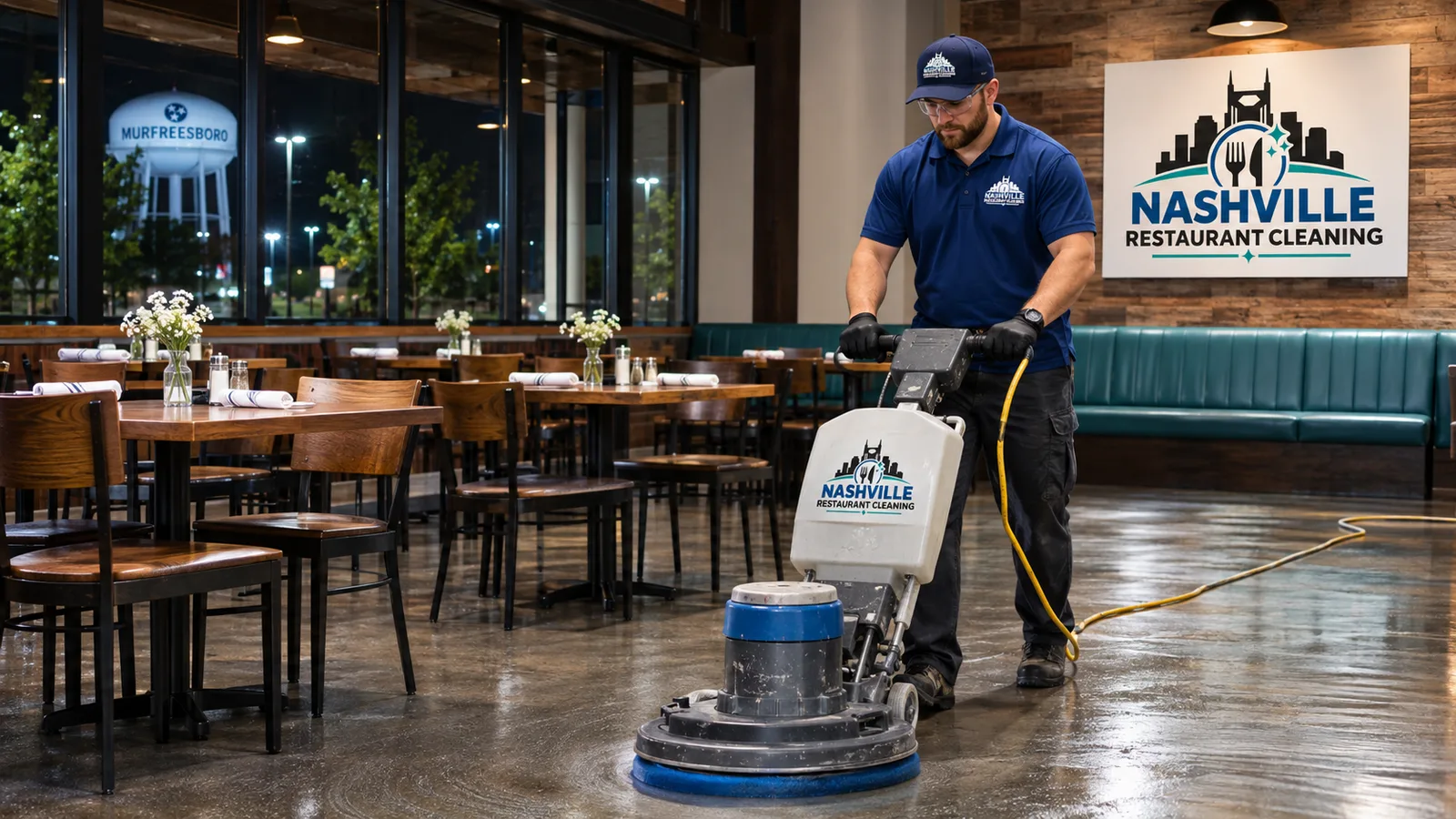
A trained commercial cleaner using a floor machine in a clean Murfreesboro restaurant dining room after closing, with tables arranged neatly and no customers present.

Restaurant Cleaning · Murfreesboro

Restaurant Cleaning Services in Murfreesboro

Dependable cleaning for kitchens, dining rooms, restrooms, and customer-facing areas, scheduled around your operating hours and built to match the way your restaurant works.

✓Written cleaning scope

✓Kitchen and dining areas

✓Surface-specific methods

✓Scheduled around operations

Scope-based local service

Restaurant Cleaning Services Murfreesboro Operators Can Plan Around

Restaurant Cleaning Services Murfreesboro businesses rely on should support daily operations without getting in the way of food preparation, guests, or closing duties. Nashville Restaurant Cleaning develops a written scope around your floor plan, service schedule, busiest areas, and division of responsibilities. The result is a practical routine for the spaces your staff and customers use every day.

Our team cleans restaurants as a professional restaurant company in Nashville while serving operators in nearby Murfreesboro with the same clear communication and scope-based approach. We account for the realities of local service, including late closing times, heavy weekend traffic, and the extra soil tracked inside during Middle Tennessee's wet spring weather. Restaurants near the Stones River Town Centre may have broad customer-facing areas and steady parking-lot traffic, while downtown Murfreesboro establishments often need work planned around compact layouts and active evening trade.

Before service begins, we identify surfaces, equipment boundaries, sensitive areas, access instructions, and tasks that remain with restaurant employees. That preparation reduces crossed wires. It also lets managers compare completed work against a defined checklist instead of a vague promise to clean the building.

Request a Callback

Food-service cleaning

A Cleaning Scope Built for Food-Service Spaces

Restaurant cleaning is different from general office cleaning. Grease can migrate beyond the cook line, food debris collects beneath movable equipment, and dining-room floors may need a method suited to tile, sealed concrete, luxury vinyl tile, or another finish. Restrooms and entry glass also need attention because customers notice those areas immediately.

A typical scope can include degreasing accessible kitchen surfaces, wiping exterior equipment panels, cleaning prep-area floors, removing soil around floor edges, and servicing dining rooms, bars, host stands, entries, and restrooms. High-touch points such as door handles, railings, and payment-area surfaces can be added to the checklist. We distinguish cleaning, which removes soil, from sanitizing, which uses an appropriate product according to its label and required contact time.

The exact scope depends on the restaurant. A counter-service operation near Middle Tennessee State University may need close attention to rapid table turnover and entry floors, while a sit-down restaurant around The Avenue Murfreesboro may prioritize larger dining areas, restrooms, and visible glass. We do not assume that the same checklist fits both.
Request a Callback
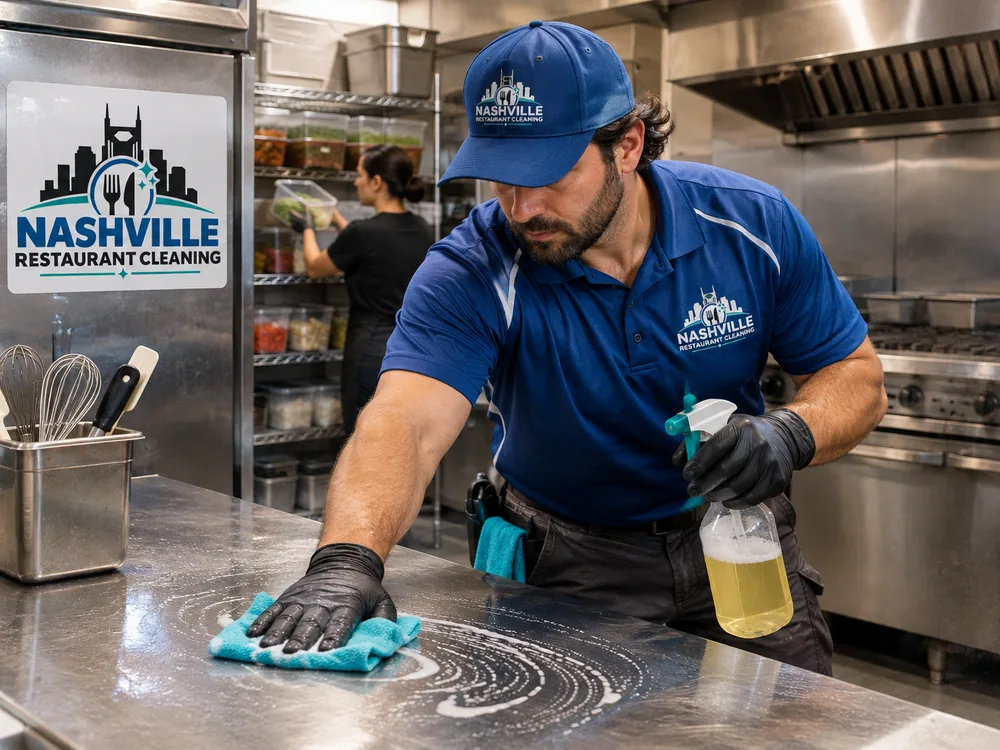
A commercial cleaner degreasing accessible stainless-steel prep surfaces in a restaurant kitchen while food is put away and the cooking line is inactive.
Kitchen work is defined by surface type, access, and approved cleaning methods.

Restaurant work zones

What Restaurant Cleaning in Murfreesboro Can Cover

Kitchen and Prep Areas

Degreasing accessible surfaces, cleaning exterior equipment panels, scrubbing floors, detailing edges, and addressing food debris in reachable areas. Equipment interiors, active cooking surfaces, and specialized exhaust work are included only when specifically written into the scope.

Dining Rooms and Bars

Table bases, chair legs, booths, ledges, bar exteriors, partitions, and floors can be cleaned after guests leave. Methods are selected for the surface rather than applying one chemical or tool throughout the room.

Restrooms and Touchpoints

Fixtures, dispensers, mirrors, partitions, floors, door handles, and other high-touch points receive checklist-based attention. Disinfectants are applied according to the product label, including the stated dwell time.

Entries and Customer-Facing Glass

Entry doors, interior glass, vestibules, mats, and nearby floors can be maintained to address fingerprints, tracked soil, and wet-weather residue before the next service period.

Periodic Detail Cleaning

Scheduled detail work can target baseboards, floor edges, wall splashes, vents, movable furniture, and buildup missed during daily closing routines. Frequency is based on use and observed condition.

Waste and Closing Support

Trash removal, liner replacement, and cleaning around waste stations can be assigned clearly. The written scope states where waste is taken and which handling duties remain with restaurant staff.

Walkthrough to review

How We Set Up a Reliable Cleaning Program

  1. 01

    Walk Through the Restaurant

    We review the kitchen, dining room, restrooms, storage boundaries, entries, and access points. The walkthrough also identifies floor materials, grease-prone areas, movable items, and spaces that cleaners should not enter.

  2. 02

    Define Tasks and Frequency

    Each task is assigned a frequency such as every visit, weekly, or periodic. We also document service windows, alarm or key procedures, waste handling, and any products restricted by the operator.

  3. 03

    Prepare a Written Scope

    The proposal states what is included, what is excluded, and how recurring work is priced. This gives managers a usable standard for reviewing the service before approving it.

  4. 04

    Complete the Scheduled Work

    Cleaning follows the approved checklist and access plan. Crews work around the agreed operating window so the restaurant can prepare for its next shift.

  5. 05

    Review and Adjust

    Managers can report changing needs, recurring problem areas, or special events. The scope can then be adjusted rather than relying on informal instructions that are easy to miss.

Request a Callback
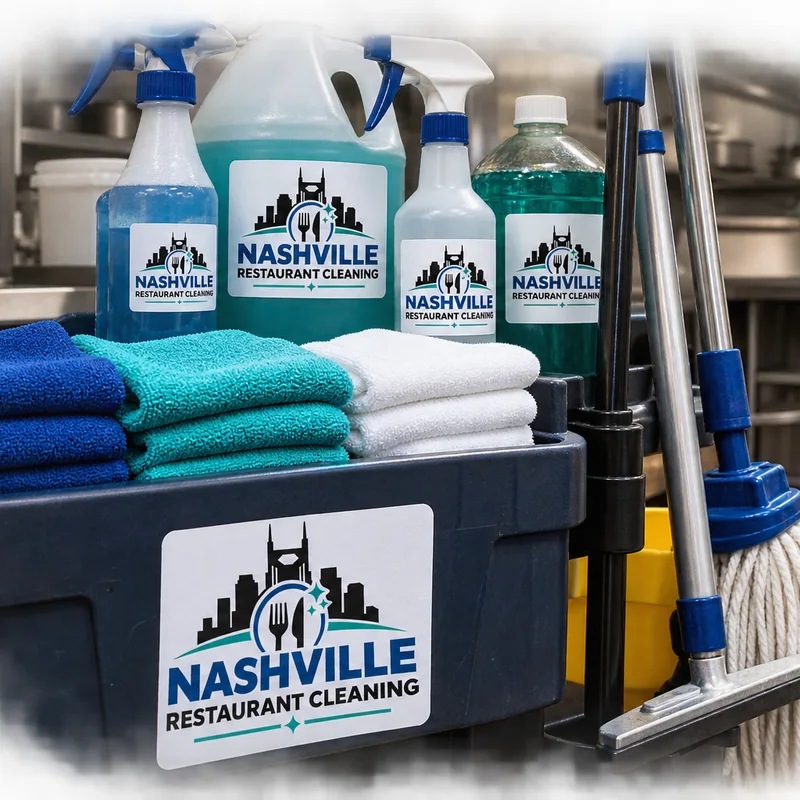
Close-up of color-coded microfiber cloths, labeled commercial cleaning products, and floor-care tools arranged on a janitorial cart inside an inactive restaurant kitchen.
Tools and products are separated by task and used according to surface requirements.

Methods and controls

Cleaning Methods Matter as Much as the Checklist

Good results depend on chemical choice, dilution, dwell time, tools, and the order of work. Degreasers need to be compatible with the surface. Sanitizers and disinfectants must remain wet for the contact time on their labels. Color-coded microfiber cloths and separate tools can reduce cross-contact between restrooms, dining spaces, and food-service areas.

Floor care also requires judgment. A kitchen floor with grease residue may need agitation and extraction, while a finished dining-room floor may require a neutral cleaner that does not leave a dull film. Slip risk must be controlled with proper rinsing, recovery of dirty solution, wet-floor signs, and enough drying time before employees return.

Food must be secured before cleaning begins, and chemicals should never be applied contrary to their labels. Cleaning supports a restaurant's sanitation program, but it does not replace employee food-safety duties or oversight from the Tennessee Department of Health. The operator remains responsible for its food handling, equipment procedures, and regulatory requirements.

Request a Callback

Local operating windows

Scheduling Around Murfreesboro Restaurant Operations

The right service window depends on when the kitchen closes, how long employees need for shutdown, and when opening staff arrive. Some restaurants prefer cleaning after the final closing routine. Others need early-morning service so floors have time to dry and managers can inspect the building before food preparation starts.

Seasonal conditions affect the plan. Rain and winter precipitation can increase moisture and grit at entries, so mats, vestibules, and nearby floors may need added attention. Pollen common to Middle Tennessee can also collect on entry glass and ledges during spring. These conditions do not require a completely different program, but they may justify a temporary frequency change.

Special events, catering production, and university calendars can change traffic for restaurants near Middle Tennessee State University. Downtown events may have a similar effect on establishments close to the Public Square. When managers share those dates in advance, periodic detail work or an added service can be planned for a quieter window rather than interrupting a busy shift.

Request a Callback

Clear, property-specific pricing

What Determines the Price of Restaurant Cleaning?

Restaurant cleaning is normally priced after a walkthrough because square footage alone does not show the workload. The largest cost drivers are service frequency, kitchen grease levels, number of restrooms, floor type, dining-room capacity, operating hours, and the amount of detail work included.

Access also matters. A clear floor that can be scrubbed efficiently takes less time than a tightly arranged room with furniture or equipment that must be moved and replaced. Heavy initial buildup may require a separate first service before recurring maintenance can begin. Consumables, interior equipment cleaning, high-access work, and unusual waste handling should be identified rather than assumed.

A written proposal should separate recurring tasks from periodic projects and state any exclusions. Nashville Restaurant Cleaning confirms the exact price after reviewing the Murfreesboro property, requested schedule, and current conditions.

Request a Callback

A walkthrough turns general cleaning needs into a defined scope, realistic schedule, and clear responsibilities for both the cleaning crew and restaurant staff.

Call for a Free Quote

Before you schedule

Questions About Restaurant Cleaning Murfreesboro Managers Ask

How often should a Murfreesboro restaurant schedule professional cleaning?+

The right frequency depends on customer volume, menu, operating hours, and what the restaurant's employees clean during each shift. Busy kitchens may need recurring floor and grease-control work several times a week, while some dining-room detail tasks can be weekly or periodic. Entry care may need temporary adjustments during Middle Tennessee's rainy or high-pollen periods.

Can cleaning be completed after the restaurant closes?+

Yes, service can be planned for an agreed period after closing or before opening, subject to crew availability and the time required for the scope. The walkthrough establishes kitchen shutdown timing, alarm procedures, access instructions, and when floors must be dry for employees. Murfreesboro restaurants with late weekend hours may use different weekday and weekend windows.

Do you clean both the commercial kitchen and dining room?+

Yes, a written scope can cover accessible kitchen surfaces and floors as well as dining rooms, bars, entries, and restrooms. The proposal identifies equipment interiors, cooking surfaces, exhaust systems, or high-access work separately because those tasks require specific access, methods, or scheduling.

Will restaurant cleaning satisfy a health inspection?+

Professional cleaning supports sanitation, but it cannot guarantee an inspection result or replace the operator's food-safety program. The Tennessee Department of Health regulates food-service establishments, and management remains responsible for food handling, temperature control, employee practices, equipment sanitation, and correction of cited conditions.

How long does it take to start recurring service?+

The start date depends on walkthrough availability, the size and condition of the restaurant, access requirements, and the requested schedule. An initial deep clean may be recommended when grease or floor buildup would prevent recurring maintenance from producing a consistent result. The proposed start plan is confirmed after the Murfreesboro location is inspected.

Can the checklist be changed for seasonal traffic or a special event?+

Yes, the scope can be adjusted when the restaurant gives enough notice and scheduling capacity is available. Added entry care, restroom attention, floor cleaning, or post-event work can be priced separately. This is useful for restaurants affected by downtown Murfreesboro events, university activity, or catering periods.

What should we prepare before the cleaners arrive?+

Food should be covered or stored, active cooking should be finished, and employees should complete any shutdown duties assigned to them. Managers should also clear personal items, identify damaged or sensitive surfaces, secure restricted areas, and provide current access instructions. The approved scope will state any additional preparation required.

Plan the next service

Build a Cleaning Plan Around Your Restaurant

Tell Nashville Restaurant Cleaning about your Murfreesboro location, operating hours, current trouble spots, and preferred service frequency. We will review the property and prepare a written scope based on the work your restaurant actually needs.

Plan your cleaning

Ready for a Cleaner Restaurant?

Tell us about your restaurant, priority areas, and preferred schedule. We will help define a practical cleaning scope for your Nashville property.

Request a quote

Get a Restaurant Cleaning Quote

After you submit the form, our team will review your details and contact you to discuss the property, scope, and scheduling.